Local Causes in Pflugerville
Two local conditions drive most of our leak detection calls. Homes built in the 1980s and 1990s with galvanized or polybutylene supply lines develop pinhole leaks as those materials corrode from the inside, often inside a wall or under a slab where nothing is visibly wrong until the water bill spikes.
Newer homes sit on expansive clay soil that shifts with the season, and that movement stresses supply and drain lines running under the slab until a fitting or a length of pipe finally gives way.
A bill spike in Springbrook, Highland Park, or Falcon Pointe usually sends us to the same few places first: the water heater connection, the irrigation lines out front, and the slab itself.
Signs Leak Detection Can't Wait
Rising Water Bill With No New Usage
A jump in usage with nothing changed in the household is the most common early sign of a hidden leak.
Sound of Running Water
Water audible in the walls or floor with every fixture shut off usually means a supply line leak, not a fixture problem.
Warm Spot on the Floor
A warm patch on a slab floor is a strong sign of a hot water line leaking underneath it.
Mold or Musty Smell With No Visible Source
A persistent musty smell without a visible spill often means moisture accumulating behind a wall or under flooring.
Active Leak Emergency? What To Do Before We Arrive
A leak you can see is an emergency, and so is one you can only hear or measure. These steps limit damage while we are on the way.
Check the meter
With every fixture off, watch the meter dial or leak indicator for a minute. Movement means water is escaping somewhere.
Shut off the main
If water is visible or a ceiling is sagging, close the main valve at the house. Everything inside stays dry until we find the break.
Stay clear of electrical
Keep away from wet outlets, switches and fixtures. Switch off a breaker only if you can reach the panel standing on dry floor.
Photograph and call
Take photos of the water and the meter reading, then call our 24/7 line. Please leave walls and floors uncut until we confirm the exact spot.
How the Fix Actually Works
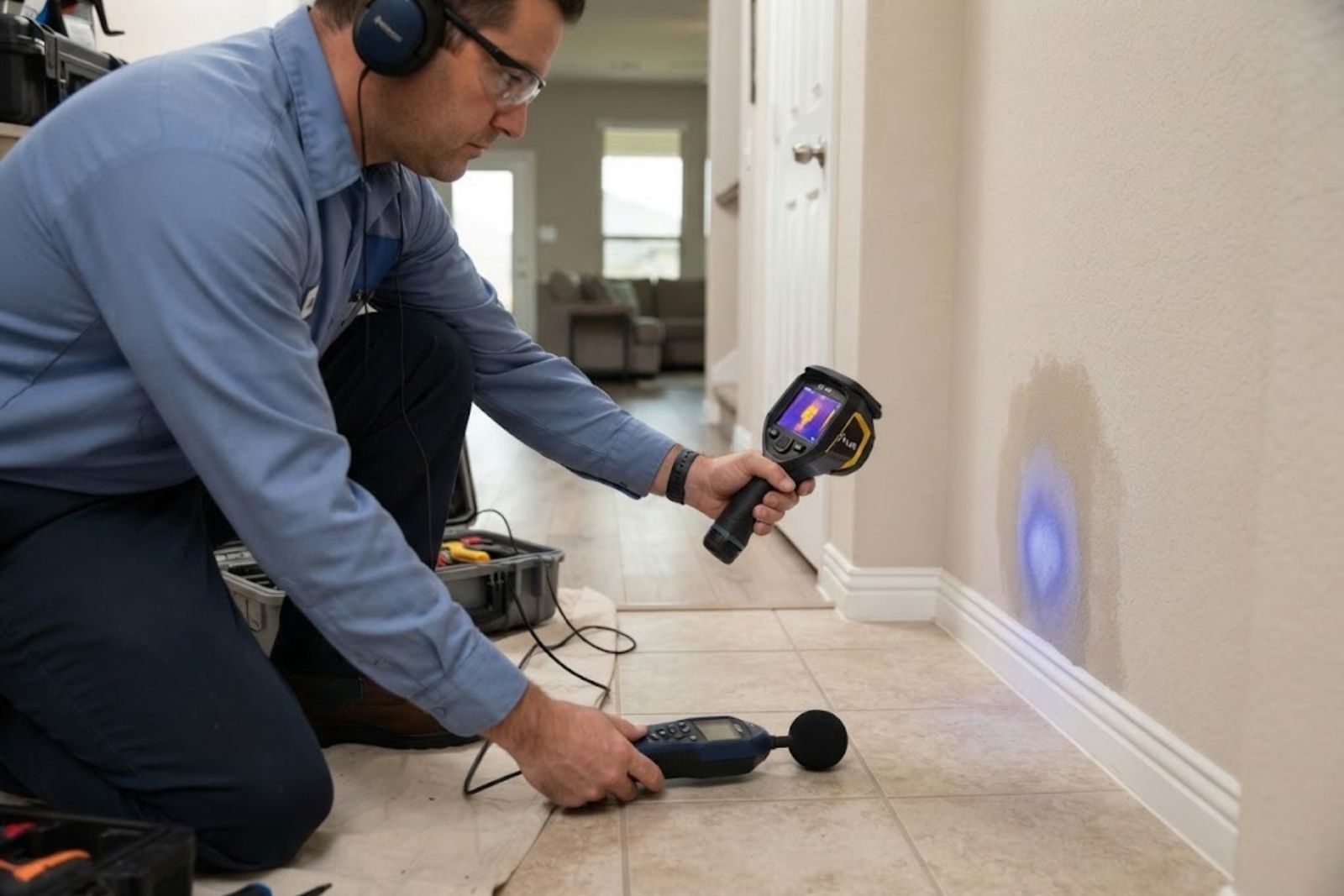
We start with the water meter. Shutting off every fixture in the house and watching whether the meter still moves confirms there's an active leak before we spend time locating it. From there, acoustic listening equipment picks up the sound of water escaping under pressure, and it's often precise enough to narrow the search to a specific section of wall or floor.
For a leak we can't pinpoint acoustically, we use thermal imaging to spot the temperature difference a hot water leak leaves in a slab or wall, which lets us confirm the leak's location before opening anything up rather than cutting exploratory holes.
Not Sure It's a Leak Yet?
If your water bill jumped, you hear water running with everything off, or a spot on the floor feels warm for no reason, that's exactly what our leak detection equipment is built to confirm before any repair work starts.
Choosing the Right Fix
Once a leak is located, the repair itself depends on where it sits and what the pipe is made of.
Guessing and Cutting Blind
- Opens walls or slab without confirming the location first.
- Often misses the actual leak point.
- More demolition than necessary.
- No way to confirm the leak is actually fixed.
Acoustic + Thermal Detection
- Confirms the leak's location before any cutting.
- Minimizes demolition to the actual leak point.
- Distinguishes supply line leaks from drain line leaks.
- Upfront price once the leak is located.
What Determines Your Price
Leak detection pricing depends mainly on the leak's location and how much equipment time it takes to pinpoint it.
Homeowners insurance often covers the resulting water damage from a sudden leak, but the plumbing repair itself is typically the homeowner's cost. Check your policy's specific language for slow leaks versus sudden ones. Want your real number? Call (512) 737-6168.
If the warm-floor pattern points specifically to a slab, our slab leak detection and repair page covers what happens next in more detail. When the corroded section turns out to run through most of the house rather than one isolated spot, a whole-home repipe is usually the more durable fix than repeated spot repairs.
A leak found along the main supply line specifically is covered on the water line repair and replacement page. We run the same detection process for Wells Branch homeowners.
What Callers Ask Us About Leak Detection
These are the situations that most often bring a call about hidden leaks, and how we approach each one.
High bill or a meter that will not stop
Most calls start with a bill that climbed or a meter moving with everything off. We begin at the meter and work outward to isolate the line.
Stains and drips from ceilings and walls
Water showing through a ceiling is often a supply or drain leak from the bath or kitchen above. We trace it back instead of opening the whole wall.
Under-house and crawlspace lines
Some lines run beneath the floor where you cannot see them. Acoustic tools help us locate a leak there before any cutting.
Yard, irrigation and buried lines
A wet patch, a lush strip of grass or an irrigation valve running fast can point to a buried line. We trace it and mark the spot.
Rentals, multifamily and business properties
Buildings with several units can leak in more than one place. We can survey a property and report where the water is going.
Pools, spas and hot tub areas
Water loss near a pool or spa sometimes comes from plumbing instead of the shell. We check the lines around it to rule them in or out.
Frequently Asked Questions
Can you find a leak without cutting into my walls?
In most cases, yes. Acoustic and thermal equipment locates the leak first, so any cutting is limited to the confirmed spot.
How do I know if I have a slab leak specifically?
A warm spot on the floor, along with a rising water bill, is the strongest early sign. See our slab leak detection and repair page for more detail.
Does a leak in one spot mean the whole system needs replacing?
Not necessarily. A single pinhole leak in an otherwise sound system is often a targeted repair, not a full repipe.
Do you offer leak detection on weekends?
Yes, our line is answered 24/7 for both scheduled inspections and active leak emergencies.
Is a hidden leak an emergency?
If the meter runs with everything off, water drips through a ceiling, or you hear running water in a wall, treat it as one and call right away. A slow leak can wait for a scheduled visit, but our line is open either way.
What if another plumber could not find my leak?
That is a common reason people call us. We start fresh at the meter, listen along the lines and confirm the location before anything is cut.
Can you find a leak in an attic or ceiling?
Yes. We trace attic and ceiling leaks back to the supply line, drain or fixture feeding them, which is often in a different spot than the stain.
Still have a question about Leak Detection in Pflugerville? Call (512) 737-6168 and we'll answer it directly.